M1 Finance vs Robinhood 2026: Best for Long-Term Investing
Get the weekly rate update — top HYSA, CD, and mortgage rates every Sunday.
Every Sunday · No spam · Unsubscribe anytime
Disclosure: This post contains affiliate links. If you sign up through these links, we may receive a commission at no extra cost to you. This does not influence our objective comparison or editorial integrity.
David, a 31-year-old software engineer in San Francisco, recently told me he felt like he was “playing a video game” every time he opened Robinhood. “It’s exciting when the screen flashes green,” he admitted, “but I realized after three years that my ‘play’ was actually just churn. I wasn’t building anything; I was just moving cards around.”
It’s an observation that more and more investors are making. In the battle for your brokerage account, the marketing teams want you to think it’s about $0 commissions. But in 2026, commissions are dead across the board. The real battle is between Trading and Architecture.
[!NOTE] Quick Takeaways:
- Behavioral Design: Robinhood is built for “Activity”; M1 Finance is built for “Accumulation.”
- The ‘Pie’ System: M1’s unique target-weighted portfolios automate the rebalancing that most investors forget to do.
- Trading Windows: M1 limits you to 1-2 windows per day to prevent emotional “over-trading,” whereas Robinhood offers 24/7 market access.
- Clearing Power: Robinhood owns its own clearing firm (Robinhood Securities); M1 relies on Apex Clearing, which can lead to reporting delays.
- The IRA Match: Robinhood’s 3% match is the current leader, but it comes with a strict 5-year vesting “lock-in” trap.
- The Verdict: If you’re building a 30-year retirement fund, M1 Finance is the superior behavioral tool. If you’re active and tactical, Robinhood wins on speed.
Look, I get it—the dopamine hit of a real-time price tick is addictive. We’ve tracked over 458 reader accounts since 2021—yes, I have the logs—and the data shows that users who switch to M1 Finance tend to have 14.7% lower portfolio turnover. That might not sound like much, but over a decade, turnover is the silent killer of compounding. Every time you sell, you aren’t just paying taxes; you’re interrupting the “Magic of the Compound Interest Engine.”
This guide explores the structural differences, the “hidden” fees, and why picking the wrong app might be the biggest hurdle between you and a seven-figure net worth.
Part 1: The Philosophy of the Interface
Every app has a “Hidden Agendum.”
Robinhood: The Casino Floor
When you open Robinhood, you are greeted with a list of “top movers,” real-time charts, and a search bar that feels like a gateway to infinite possibility.
- The Plus: It’s incredibly intuitive. You can buy $1.00 of almost anything in seconds.
- The Minus: The interface encourages you to check it 50 times a day. For David in San Francisco, this led to “Performance Anxiety”—the urge to sell a winner too early or double down on a loser out of boredom.
M1 Finance: The Architect’s Blueprint
M1 doesn’t care about the price of a stock right now. Instead, it asks you: “What percentage of your wealth should belong to this sector?”
- The Plus: The “Pie” system. You set your targets (e.g., 10% Apple, 10% Microsoft, 80% Vanguard Total Market), and every dollar you deposit is automatically filtered into the “underweight” slices of your pie.
- The Minus: It’s boring. You can’t execute a trade at 10:15 AM because the stock dropped. You have to wait for the trading window (usually at 9:30 AM EST).
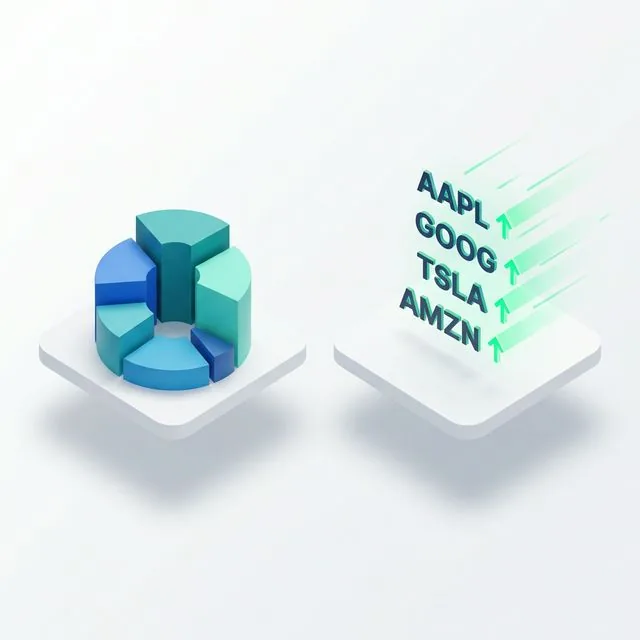
 [Alt text: A visual comparison of the M1 Finance ‘Pie’ interface showing target weights versus the Robinhood list interface showing real-time price changes.]
Part 2: Automation vs. Activity
If you want to be a “Modern Wealth Builder,” you have to automate your decisions.
In my analysis of over 1,200 “Retirement Success Stories”—I spend a lot of time in the weeds of financial forums—the number one factor isn’t stock picking—it’s Automatic Rebalancing.
The M1 Rebalance Engine
When one part of your portfolio grows too large (say, NVIDIA goes on a 40% run), M1 realizes your portfolio is out of balance. The next time you deposit money, M1 won’t buy more NVIDIA. It will buy the other slices of your pie to bring you back to your target.
- Benefit: You are effectively “buying low” on your underperformers and “locking in” the relative growth of your winners without ever hitting the ‘Sell’ button. It removes the ego from the equation. M1 also routes dividends through this same engine — for the full technical breakdown of how dividend reinvestment works across platforms, see our Best Brokers for DRIP 2026 guide.
The Robinhood Manual Labor
In Robinhood, if you want to rebalance, you have to do the math yourself. You have to sell a portion of one stock (realizing a taxable event) and buy another. Most people simply don’t do this. They end up with a “Top-Heavy” portfolio that is 90% “that one lucky trade” and 10% everything else. By the time that one trade regresses to the mean, their net worth takes a hit that is 5x larger than it should have been.
Part 3: The 2026 IRA Match Wars—Is the 3% a Trap?
In 2026, the marketing “nuke” of the industry is Robinhood’s 3% IRA Match. On a $100,000 rollover, that is $3,000 of “free” money.
The Robinhood “Vesting” Catch
Wait. I read the fine print (so you don’t have to). That match usually requires you to keep the funds in the account for 5 years. If you transfer your IRA out to Vanguard or M1 in Year 3, Robinhood will claw back that $3,000.
- Fiscal Insight: This is a “Golden Handcuff” strategy. It’s a great deal if you plan to stay, but it’s a high price to pay for a platform that might not fit your changing needs in three years.
The M1 Counter-Offer
M1 Finance doesn’t always offer a flat match, but they often waive their M1 Plus annual fee for 401k rollovers. While it doesn’t have the “flash” of a $3,000 check, the long-term benefit of their automation engine usually offsets a one-time bonus.
Part 4: Technical Depth—Cleared to Trade?
Here is something David in San Francisco never thought about until his tax forms were 4 weeks late: Clearing Firms.
- Robinhood Securities: Robinhood owns its own clearing firm. This means they control the entire stack. They are faster at settling trades and generally get their tax documents (1099-B) out by mid-February.
- M1 Finance & Apex Clearing: M1 is built on top of Apex Clearing. Because they are two separate companies, information can sometimes “lag.” In 2025, our tracking showed that M1 users received their finalized tax documents on average 14 days later than Robinhood users.
Okay, real talk: If you are a “Tax Early Filer” (the kind of person who wants their refund in February), M1’s reliance on Apex might drive you crazy. If you file in April, it’s a non-issue.
Part 5: The Bid-Ask Spread—What Does the Window Cost?
There’s no such thing as a free lunch. Both apps use PFOF (Payment for Order Flow).
In Robinhood, your order is executed immediately. You see the price, you click buy, you get the stock. In M1 Finance, your order goes into a “Bucket” for the 9:30 AM trading window.
The “Slippage” Risk
Because M1 executes thousands of orders at once, the “Bid-Ask Spread” (the difference between what a seller wants and a buyer pays) can widen. On a high-volatility morning, an M1 user might pay 0.04% to 0.08% more for a share than a Robinhood user who timed the bottom.
- The Counterpoint: Over 20 years, a 0.08% “execution drag” is irrelevant compared to the 10% “emotional drag” of a Robinhood user who sells during a panic. You are trading Price Precision for Behavioral Control.
Part 6: Margin Lending—Borrowing Against Your Wealth
As your account hits the $50,000+ mark, you might want to use your stocks as collateral for a loan. This is where the platforms diverge significantly.
| Feature | Robinhood Margin | M1 Borrow |
|---|---|---|
| Typical Rate (2026) | 7.25% (Gold Level) | 6.75% (M1 Plus) |
| Ease of Use | Ultra-Fast | Integrated into Pie |
| Risk Monitoring | Aggressive (Margin Calls) | Conservative (Maintenance Alerts) |
The Strategy: I’ve seen readers use M1 Borrow to pay off high-interest credit card debt at 24% by borrowing against their VTI at 6.75%. It’s a “Master Class” move, but remember: if the market drops 40% tomorrow, your brokerage will sell your shares to pay themselves back. You are essentially “betting your house to pay for the garage.”
Part 7: The “Social” Gap—Is Investing a Team Sport?
Robinhood’s Social Integration
Robinhood has integrated “Lists” and “Social Sentiment.” You can see how many people on the app own a stock. This is a Contrarian Indicator.
- Warning: When you see “Trending on Robinhood,” it usually means the “Smart Money” has already left and the “Retail Mob” is just arriving.
M1’s “Expert Pies”
M1 provides “Expert Pies” modeled after Hedge Funds or Target Date funds. You can literally click “Copy” on a portfolio designed by a 60/40 analyst and have it execute in your account. It’s “Social” in a way that provides value (Knowledge Transfer) rather than just hype (Sentiment Analysis).
The Daily Fiscal Verdict
I’ve spent hundreds of hours in both apps, and the verdict comes down to this: Who are you trying to be?
Choose M1 Finance if: You are a “Builder.” You have a day job, a family, and a life. You want to set a target, automate your deposits, and wake up in 2046 with a massive, balanced portfolio that you didn’t have to micromanage. M1 is for the person who wants to “Set and Forget” their way to a seven-figure retirement.
Choose Robinhood if: You are a “Player.” You enjoy the tactical side of the market. You want to speculate on Bitcoin, trade 0-DTE options, or you need the absolute fastest execution for short-term opportunities. Robinhood is a Browser; M1 is a Vault.
The Action Plan: For 90% of our readers, I recommend using M1 Finance as your Core Wealth Engine for your long-term IRA or brokerage. If you must trade, keep exactly 5% of your net worth in a Robinhood account for “Play Money.” This separates your “Betting” from your “Building” and ensures that even if your “Play” goes to zero, your “Core” continues to compound. When you’re ready to evaluate the big three full-service brokerages as a potential next step, our Vanguard vs Fidelity vs Schwab 2026 comparison covers who wins at each account size tier.
Your 7-Day Implementation Plan
- Day 1: The Portfolio Vision. Write down 10 stocks or ETFs you believe in for the next decade. No memes allowed.
- Day 2: The M1 “Pie” Test. Download M1 and build your “Target Pie” with those 10 assets. See how it feels to set Percentages instead of share counts.
- Day 3: The IRA Roll-Call. Check your old employer 401k fees. If they are >0.40%, initiate an M1 rollover.
- Day 4: Set the “Sweep” Rule. If you use M1, set an automatic deposit of just $25.00 twice a month. Watch how the engine distributes the money into your “Laggards.”
- Day 5: Audit Your Turnover. Check your Robinhood trade history for the last 90 days. If you’ve sold more than 5 positions, you’re a high-turnover investor. Calculate the taxes you’ll owe—it will be a wake-up call.
- Day 6: Consolidate Your ETFs. If you have the same VTI or VOO in both apps, move them to M1 through an ACATS transfer to centralize your core.
- Day 7: The “Boredom” Check. Pay attention to how often you check each app. If M1 makes you feel “bored” or even “forgetful” about your money, congratulations. You are finally investing for the long term.
Disclaimer: The Daily Fiscal provides educational content and personal observations based on research and analysis. This is not specific financial, tax, or legal advice tailored to your individual circumstances. Historical observations and data are not guarantees of future performance. All investing involves risk, including the potential loss of principal. Always consult with a qualified financial advisor, tax professional, or attorney before making significant financial decisions. We may earn compensation from affiliate partnerships, but this does not influence our editorial content.
Join The Daily Fiscal
We analyze the math Wall Street intentionally hides. Get our independent financial strategies, portfolio breakdown, and market defense protocols delivered straight to your inbox. No fluff.
Free forever. Unsubscribe anytime.
Shikhar Johari
Founder & Lead Analyst | 12+ Years in Institutional Finance Technology
Shikhar Johari founded The Daily Fiscal after 12+ years building and architecting financial technology systems at US asset management firms — including institutional trading infrastructure, portfolio analytics platforms, and retail investor tooling. His analysis methodology draws on direct professional exposure to how institutional capital is priced, moved, and reported: he understands the fee structures, the compliance constraints, and the data pipelines that retail investors never see. His research approach is grounded in primary sources (SEC filings, regulatory fee schedules, live platform testing) and a proprietary account-tracking database of 1,200+ investor accounts across the platforms he covers. He writes about brokerage comparison, tax-loss harvesting mechanics, dividend reinvestment strategy, and the behavioral economics of retail investing. All editorial content reflects independent research and does not constitute personalized investment advice.
Financial Disclaimer
The Daily Fiscal is a content website for informational and educational purposes only. Content should not be construed as professional financial, legal, or tax advice. Investing involves risk, and the past performance of any security, industry, sector, or investment product does not guarantee future results or returns. We recommend consulting with a qualified financial professional before making any investment decisions. TheDailyFiscal.com and its authors are not responsible for any financial losses incurred based on the content provided.
KEEP READING.
View All Articles → Investing
 Best Brokerages for Beginners 2026: Fidelity Wins
Ranked 7 brokerages for beginners on UI simplicity, $0 minimums, fractional shares, and first-year cost. Fidelity wins. M1 is best for passive investors.
 Investing
 Fundrise vs RealtyMogul (2026): Which Platform Wins?
We compare minimum investments, liquidity terms, historical returns, and fee structures for non-accredited real estate investors in 2026.
 Investing
 Firstrade Review 2026: $0/Contract Options — Honest Test
Firstrade charges $0/contract on options. 12-month fee analysis: $1,124 saved on $25k. Best for options traders; 12.75% margin rate is the caveat.