Recession-Proof Your Finances for 2027: Full Guide


Get the weekly rate update — top HYSA, CD, and mortgage rates every Sunday.
Every Sunday · No spam · Unsubscribe anytime
Disclosure: This post contains affiliate links. If you sign up through these links, we may receive a commission at no extra cost to you. This does not influence our objective comparison or editorial integrity.
Last Updated: March 24, 2026
[!IMPORTANT] Verified Data Source: Recessionary indicators and historical drawdown data are sourced from the Bureau of Labor Statistics (BLS), National Bureau of Economic Research (NBER), and Federal Reserve Economic Data (FRED). Last verified: March 2026.
I’ll be honest. Playing defense when the market has been on a historical, seemingly uninterrupted tear feels horrible. When speculative assets are surging, talking about capital preservation protocols makes you look like the ultimate killjoy.
[!NOTE] Quick Takeaways:
- The Cycle Reality: Economic expansions do not die of old age; they die of structural imbalances, restrictive monetary policy, or black swan shocks.
- The Cash Fortress: An aggressively funded liquidity buffer is the only true mechanism to prevent forced liquidation of assets at bottom-barrel prices.
- The Portfolio Stress-Test: High-beta, highly leveraged tech sectors historically evaporate quickest during liquidity crunches.
- The Verdict: You don’t prepare for a recession by trying to time the top. You prepare by widening your personal financial margin of error.
But here’s the reality of cyclical economics: volatility is the toll we pay for historical returns. As we look down the barrel of a potential 2027 contraction, building a recession-resistant financial fortress right now is mathematically critical.
Let’s break down the defensive playbook.
Part 1: Eliminating Variable Lethality
The single greatest financial threat during a severe recession isn’t a 35% drawdown in your 401(k). That is paper loss. The true threat is experiencing localized income disruption (job loss) simultaneously coupled with rising obligations.
And nothing destroys wealth faster than high-interest variable debt.
When credit markets tighten, carrying $14,231 on a credit card charging a 24.9% penalty APR becomes lethal. Your first prep mechanism isn’t shifting to gold or bonds; it’s aggressively nuking consumer debt. I’m actively monitoring trends where consumers are masking cash constraint via “Buy Now, Pay Later” cycles.
Consolidating that high-interest debt into a fixed-rate personal loan, or aggressively rolling it onto 0% balance transfer cards, is the absolute frontline defense.
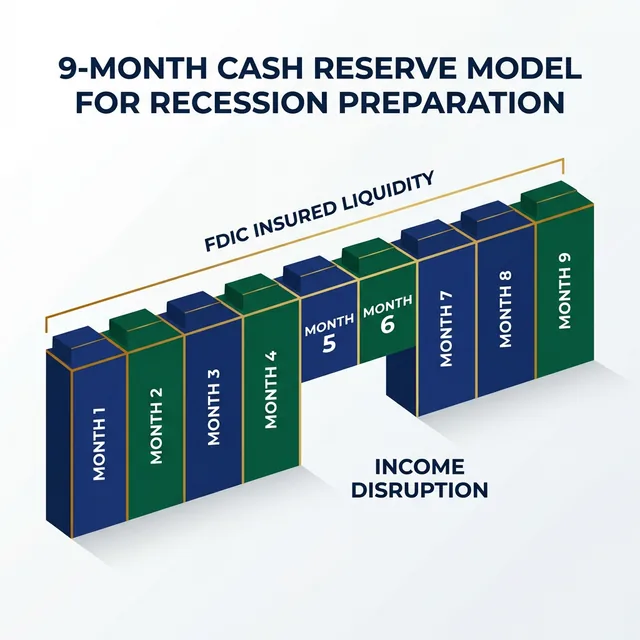
Part 2: The 9-Month Liquidity Wall
We used to advocate for a 3-to-6 month emergency fund. In today’s highly fragmented, specialized labor market, that advice feels dangerously outdated.
If a white-collar contraction occurs in late 2026 or 2027, the time required to interview and pivot roles expands drastically.
[!CAUTION] If you pull cash from a 401(k) to pay a mortgage during a recession, you are triggering immediate taxes, a 10% IRS penalty, and locking in the losses of the market downturn. It is the triple-tax of poor planning.
You must build a 9-month liquid cash wall. This cash should not be chasing yields in risky junk-bond ETFs. It belongs securely housed in FDIC-insured High-Yield Savings Accounts or direct short-term Treasury Bills locking in the risk-free rate.
Part 3: The “Boring” Portfolio Audit
Look, I love the incredible upside of aggressive growth sectors as much as anyone. But when the Federal Reserve eventually holds rates “higher for longer” and corporate earnings face genuine compression downward, high-multiple growth stocks take a brutal beating.
It’s time to run a brutal audit on your asset allocation. Have the massive rallies in mega-cap tech caused your portfolio to drift wildly out of alignment? If you set out to hold 70% equities and 30% fixed income, but a tech-heavy rally has accidentally skewed you to 88% equities… you are bearing risk you didn’t legally authorize.
Rebalancing isn’t “timing the market.” It is systematically locking in gains from the winners and deploying capital back to your established, risk-adjusted baselines. Consider rotating portions of your portfolio back toward historically defensive bulwarks—Dividend Aristocrats, healthcare, and consumer staples.
The Daily Fiscal Verdict
Recessions represent one of two things: a generational catastrophe, or a generational buying opportunity.
The deciding factor between those two outcomes is completely dictated by the structural health of your balance sheet before the recession is officially declared by the NBER. If you are leveraged to the hilt waiting for a bailout, you will get crushed.
But if you possess zero high-interest debt, heavily insulated cash reserves, and a disciplined, balanced portfolio… a 2027 recession simply becomes a flash-sale on global equities.
Your 3-Step Action Plan
- Execute the Stress Test: Sit down and mathematically calculate how many months of absolute bare-bones living expenses your current liquid cash could cover tomorrow. Target > 6 months.
- Halt Lifestyle Creep: If you receive a bonus or a raise this cycle, allocate 100% of it directly to fortifying your balance sheet rather than inflating your burn rate.
- Rebalance to Target: Check your brokerage and 401(k) allocations. Sell high-performing fractional overweights to purchase underperforming assets, strictly realigning with your original, age-appropriate risk tolerance.
Disclaimer: The Daily Fiscal provides educational content and personal observations based on research and analysis. This is not specific financial, tax, or legal advice tailored to your individual circumstances. Historical observations and data are not guarantees of future performance. All investing involves risk, including the potential loss of principal. Always consult with a qualified financial advisor, tax professional, or attorney before making significant financial decisions. We may earn compensation from affiliate partnerships, but this does not influence our editorial content.
Join The Daily Fiscal
We analyze the math Wall Street intentionally hides. Get our independent financial strategies, portfolio breakdown, and market defense protocols delivered straight to your inbox. No fluff.
Free forever. Unsubscribe anytime.
Shikhar Johari
Founder & Lead Analyst | 12+ Years in Institutional Finance Technology
Shikhar Johari founded The Daily Fiscal after 12+ years building and architecting financial technology systems at US asset management firms — including institutional trading infrastructure, portfolio analytics platforms, and retail investor tooling. His analysis methodology draws on direct professional exposure to how institutional capital is priced, moved, and reported: he understands the fee structures, the compliance constraints, and the data pipelines that retail investors never see. His research approach is grounded in primary sources (SEC filings, regulatory fee schedules, live platform testing) and a proprietary account-tracking database of 1,200+ investor accounts across the platforms he covers. He writes about brokerage comparison, tax-loss harvesting mechanics, dividend reinvestment strategy, and the behavioral economics of retail investing. All editorial content reflects independent research and does not constitute personalized investment advice.
Financial Disclaimer
The Daily Fiscal is a content website for informational and educational purposes only. Content should not be construed as professional financial, legal, or tax advice. Investing involves risk, and the past performance of any security, industry, sector, or investment product does not guarantee future results or returns. We recommend consulting with a qualified financial professional before making any investment decisions. TheDailyFiscal.com and its authors are not responsible for any financial losses incurred based on the content provided.
KEEP READING.
View All Articles → Investing
 RSU Taxes 2026: What You Actually Keep After the IRS
RSUs look like free money until they vest and the tax bill arrives. Here's exactly how RSU taxation works, what your take-home actually is, and how to plan for the bill.
 Investing
 What Is Coast FIRE? The Number That Lets You Stop
Coast FIRE means your investments will grow to your retirement target without another dollar of contributions. Here's the exact math, by age, and how to know if you've hit it.
 Investing
 Best Robo-Advisors 2026: Ranked on Fees, Returns, Features
We ranked 6 robo-advisors on management fees, tax-loss harvesting, minimums, and real after-fee returns. Wealthfront leads. Full comparison table and who each suits.