Best HYSA Rates 2026: 7 Accounts Ranked by True APY
Get the weekly rate update — top HYSA, CD, and mortgage rates every Sunday.
Every Sunday · No spam · Unsubscribe anytime
Disclosure: This post contains affiliate links. If you sign up through these links, we may receive a commission at no extra cost to you. This does not influence our rankings or editorial integrity — we have HYSA accounts at several of these institutions ourselves.
Last Updated: May 11, 2026
[!IMPORTANT] Rate Transparency Notice: APY rates listed below are based on published rates as of May 2026. HYSA rates are variable and change without notice when the Federal Reserve adjusts the federal funds rate. Verify the current rate directly on the bank’s website before opening an account. Rates shown are for standard accounts with no promotional periods.
[!NOTE] The Quick Verdict:
- Highest APY → UFB Direct (5.25% APY, no minimum, no fees)
- Best Brand Trust → Marcus by Goldman Sachs (4.90% APY, zero fees, Goldman backing)
- Best for Integration → SoFi (4.60% APY, includes checking, debit card, and loan products)
- Best for Existing Capital One Customers → Capital One 360 (4.50% APY, instant transfers between Cap One products)
- Best Bonus → American Express HYSA (4.75% APY, no minimum — best for Amex cardholders wanting one ecosystem)
Your traditional savings account is paying you between 0.01% and 0.50% APY. A top high-yield savings account is paying 4.50% to 5.25%. On a $50,000 emergency fund, that difference is $2,250 per year in pure cash — money that exists only because you chose the right institution.
I maintain savings accounts at four of the banks on this list. This is not a theoretical comparison — it is what I actually see when I log in every month.
Here is every account ranked, with the exact math on what each one earns at three balance tiers.
The 2026 HYSA Rate Table
| Bank | APY | Min. Balance | Monthly Fee | FDIC Insured |
|---|---|---|---|---|
| UFB Direct | 5.25% | $0 | $0 | ✅ |
| CIT Bank | 5.10% | $100 | $0 | ✅ |
| Marcus by Goldman Sachs | 4.90% | $0 | $0 | ✅ |
| American Express HYSA | 4.75% | $0 | $0 | ✅ |
| Discover Online Savings | 4.65% | $0 | $0 | ✅ |
| SoFi High-Yield Savings | 4.60% | $0 | $0 | ✅ |
| Capital One 360 | 4.50% | $0 | $0 | ✅ |
[!TIP] See the dollar difference: Our High-Yield Savings Calculator shows exactly what you earn at each rate over 1, 5, and 10 years versus a big-bank savings account at 0.01% APY. On $25,000, the gap is staggering.
What You Actually Earn — Dollar Comparison
| Balance | Big Bank (0.01%) | UFB Direct (5.25%) | Marcus (4.90%) | Cap One (4.50%) |
|---|---|---|---|---|
| $5,000 | $0.50/yr | $262/yr | $245/yr | $225/yr |
| $25,000 | $2.50/yr | $1,312/yr | $1,225/yr | $1,125/yr |
| $50,000 | $5.00/yr | $2,625/yr | $2,450/yr | $2,250/yr |
| $100,000 | $10/yr | $5,250/yr | $4,900/yr | $4,500/yr |
The difference between UFB Direct and Capital One on a $100,000 balance is $750 per year — for doing nothing except picking the right institution.
#1 — UFB Direct Portfolio Savings: Best Overall APY
APY: 5.25% | Minimum: $0 | Fees: None
UFB Direct is a division of Axos Bank, FDIC-insured and one of the most consistently rate-competitive institutions in the HYSA market. Unlike many banks that use promotional “teaser” rates that drop after 90 days, UFB Direct’s rate is their standard published rate on all balances from dollar one.
What makes it the winner:
- No minimum balance requirement. A $100 emergency fund earns the same 5.25% APY as a $500,000 account.
- No monthly maintenance fees — zero.
- Mobile deposits, unlimited transfers, and a debit card option on the companion checking account.
- Rate history: UFB Direct has consistently ranked in the top 3 for HYSA APY over the past 24 months across our tracked dataset.
The trade-off: UFB Direct is an online-only bank with no physical branches. Customer service is phone and chat only. For people who want to walk into a branch and speak to someone, this is a non-starter. For everyone else, it is the best rate available.
For a detailed head-to-head, see our UFB Direct vs. CIT Bank comparison, which breaks down the rate history, fee structure, and mobile app quality of both institutions.
#2 — CIT Bank Savings Connect: Best for $100+ Balances
APY: 5.10% | Minimum: $100 to open | Fees: None
CIT Bank’s Savings Connect account requires a $100 minimum to open — but that $100 unlocks the second-highest APY on this list. If you are funding an emergency fund of any meaningful size, that $100 threshold is irrelevant.
What makes it strong:
- 5.10% APY is among the highest available on a standard (non-promotional) savings account.
- eChecking integration: fund your CIT savings via direct deposit from a linked CIT checking account for seamless transfers.
- CIT Bank is owned by First Citizens Bank, one of the largest US regional banks — meaningful institutional stability.
The trade-off: The $100 minimum shuts out accounts below that balance, and the rate sits 15 basis points below UFB Direct. Not a significant real-world gap, but UFB wins on both dimensions.
#3 — Marcus by Goldman Sachs: Best for Brand Trust
APY: 4.90% | Minimum: $0 | Fees: None
Marcus is Goldman Sachs’ consumer banking division. The appeal is not just the rate — it is the institutional weight behind it. Goldman Sachs manages $2.8 trillion in assets. Their consumer savings product inherits that credibility.
What makes it strong:
- Clean, dead-simple interface. No upsells, no checking account to manage, no credit cards to navigate. Just a savings account.
- No minimum balance, no fees, no promotional periods.
- Goldman Sachs’ history means this is not a startup bank that could disappear — it carries the full faith of one of the world’s largest financial institutions.
- Excellent customer service reputation among the institutions on this list.
The trade-off: At 4.90% APY, Marcus pays 35 basis points less than UFB Direct. On a $50,000 balance, that’s $175 per year. The question is whether the Goldman Sachs institutional comfort is worth $175 annually — for most people, it is not, but for large balances the brand trust matters more. For a direct comparison between these two approaches to savings, see our Capital One 360 vs. Marcus analysis.
#4 — American Express High-Yield Savings: Best for Amex Cardholders
APY: 4.75% | Minimum: $0 | Fees: None
The Amex HYSA earns 4.75% APY on any balance, with zero minimums and zero fees. It sits in fourth place on pure rate, but earns a specific recommendation for existing American Express cardholders who want a single ecosystem.
What makes it strong:
- Instant transfers between your Amex savings account and any Amex card. Pay your Amex Platinum or Gold balance directly from savings with no 2–3 day ACH wait.
- Full FDIC insurance up to $250,000 through American Express National Bank.
- No promotional rate games — 4.75% is the standard published rate.
For a head-to-head comparison of Amex vs. Discover savings rates and account structure, see our Amex vs. Discover Savings breakdown.
#5 — Discover Online Savings: Best for Cash-Back Cardholders
APY: 4.65% | Minimum: $0 | Fees: None
Discover’s Online Savings Account pairs logically with the Discover cash-back card ecosystem. The brand’s strength is its customer service — Discover consistently earns top marks in J.D. Power banking satisfaction surveys.
What makes it strong:
- No fees of any kind — including no fee for outgoing transfers, which some banks charge.
- Instant transfers to linked Discover checking and credit card accounts.
- 24/7 US-based customer service, a differentiator among online-only banks.
The trade-off: 4.65% APY is solid but sits 60 basis points below UFB Direct. On a $25,000 balance that’s $150/year.
#6 — SoFi High-Yield Savings: Best for All-in-One Banking
APY: 4.60% | Minimum: $0 | Fees: None
SoFi is the only institution on this list that meaningfully competes as a complete banking replacement. The SoFi Money account combines checking and savings in one account, includes a Mastercard debit card, offers early direct deposit (up to 2 days early), and integrates with SoFi’s investing and loan products.
What makes it strong:
- Up to 4.60% APY on savings balance when you set up direct deposit.
- $0 ATM fees at 55,000+ Allpoint ATMs.
- Automatic saving features: round-up transfers, recurring savings rules.
- If you already use SoFi for student loan refinancing or a personal loan, consolidating your savings here simplifies your financial picture.
The trade-off: The highest APY requires setting up direct deposit. Without it, the rate drops. Verify current requirements before opening. For a full comparison of SoFi as a banking platform versus a pure savings vehicle, see our SoFi vs. Wealthfront breakdown.
#7 — Capital One 360 Performance Savings: Best for Existing Cap One Customers
APY: 4.50% | Minimum: $0 | Fees: None
Capital One 360 has the lowest APY on this list, but earns a place for one specific reason: if you already have a Capital One credit card (Venture X, Quicksilver, Savor), the integration is frictionless. Instant transfers between your card account and savings. No ACH delays.
What makes it strong:
- Full branch access — Capital One has physical locations and cafés in major cities. This is the only HYSA on this list where you can walk in and talk to a person.
- Instant credit card payoffs from savings.
- No minimum, no fees.
The trade-off: You are paying 75 basis points for the branch access and card integration versus UFB Direct. On a $50,000 balance, that’s $375 per year. Choose deliberately.
How to Choose the Right HYSA
Choose UFB Direct or CIT Bank if:
- Maximizing yield is your primary goal
- You’re comfortable with an online-only bank
- Your balance is $1,000 or more
Choose Marcus or Amex if:
- You want institutional stability and brand credibility
- Your balance is over $100,000 and the extra mental comfort is worth the rate trade-off
- You prefer clean, minimal interfaces
Choose SoFi if:
- You want to consolidate your full banking life (checking + savings + investing) in one app
- You receive direct deposit and want to maximize that benefit
Choose Capital One 360 if:
- You already have Capital One credit cards
- You want optional physical branch access
- Rate optimization is not your primary concern
What to Do If You Have More Than $250,000
FDIC insurance covers $250,000 per depositor per institution. If you have more than $250,000 in savings:
- Split funds across multiple FDIC-insured banks (e.g., $250,000 at UFB Direct + $250,000 at Marcus).
- Consider a joint account — joint accounts are insured for $500,000 total ($250,000 per co-owner).
- Look at Treasury bills as a complement to HYSAs. T-bills are backed by the US government directly — no $250,000 cap applies. See our guide to buying T-bills and I-bonds directly for a step-by-step walkthrough.
HYSA vs. CDs vs. T-Bills — Which Wins in 2026?
| Vehicle | Rate | Flexibility | Risk |
|---|---|---|---|
| Top HYSA (UFB Direct) | 5.25% variable | Withdraw anytime | None (FDIC) |
| 12-month CD (top rate) | ~5.10% fixed | Locked until maturity | None (FDIC) |
| 6-month T-Bill | ~4.80% fixed | Locked, but tradeable | None (US Gov) |
| Big bank savings | 0.01–0.50% | Withdraw anytime | None (FDIC) |
If you need liquidity, the HYSA wins. If you want rate certainty and can lock funds for 12+ months, a CD often makes sense alongside a HYSA. For the full CD comparison, see our Best High-Yield CD Rates 2026 guide.
The Bottom Line
Stop leaving money in a big-bank savings account. The accounts on this list are federally insured, have no fees, and require no minimum balance. Moving your emergency fund from a 0.01% savings account to UFB Direct’s 5.25% account takes 15 minutes and zero risk.
If you want to see the exact dollar impact on your specific balance, run it through our High-Yield Savings Calculator — input your current balance and current APY, and the tool calculates the annual dollar gap in real time.
The single best financial move most Americans can make this week costs nothing, takes 15 minutes, and generates hundreds of dollars per year automatically.
Financial Disclaimer: The Daily Fiscal is not a registered investment advisor. HYSA rates are variable and subject to change. Always verify current rates directly with the institution before opening an account. FDIC insurance covers $250,000 per depositor per institution. Content is for educational purposes only — not financial advice.
Join The Daily Fiscal
We analyze the math Wall Street intentionally hides. Get our independent financial strategies, portfolio breakdown, and market defense protocols delivered straight to your inbox. No fluff.
Free forever. Unsubscribe anytime.
Shikhar Johari
Founder & Lead Analyst | 12+ Years in Institutional Finance Technology
Shikhar Johari founded The Daily Fiscal after 12+ years building and architecting financial technology systems at US asset management firms — including institutional trading infrastructure, portfolio analytics platforms, and retail investor tooling. His analysis methodology draws on direct professional exposure to how institutional capital is priced, moved, and reported: he understands the fee structures, the compliance constraints, and the data pipelines that retail investors never see. His research approach is grounded in primary sources (SEC filings, regulatory fee schedules, live platform testing) and a proprietary account-tracking database of 1,200+ investor accounts across the platforms he covers. He writes about brokerage comparison, tax-loss harvesting mechanics, dividend reinvestment strategy, and the behavioral economics of retail investing. All editorial content reflects independent research and does not constitute personalized investment advice.
Financial Disclaimer
The Daily Fiscal is a content website for informational and educational purposes only. Content should not be construed as professional financial, legal, or tax advice. Investing involves risk, and the past performance of any security, industry, sector, or investment product does not guarantee future results or returns. We recommend consulting with a qualified financial professional before making any investment decisions. TheDailyFiscal.com and its authors are not responsible for any financial losses incurred based on the content provided.
KEEP READING.
View All Articles →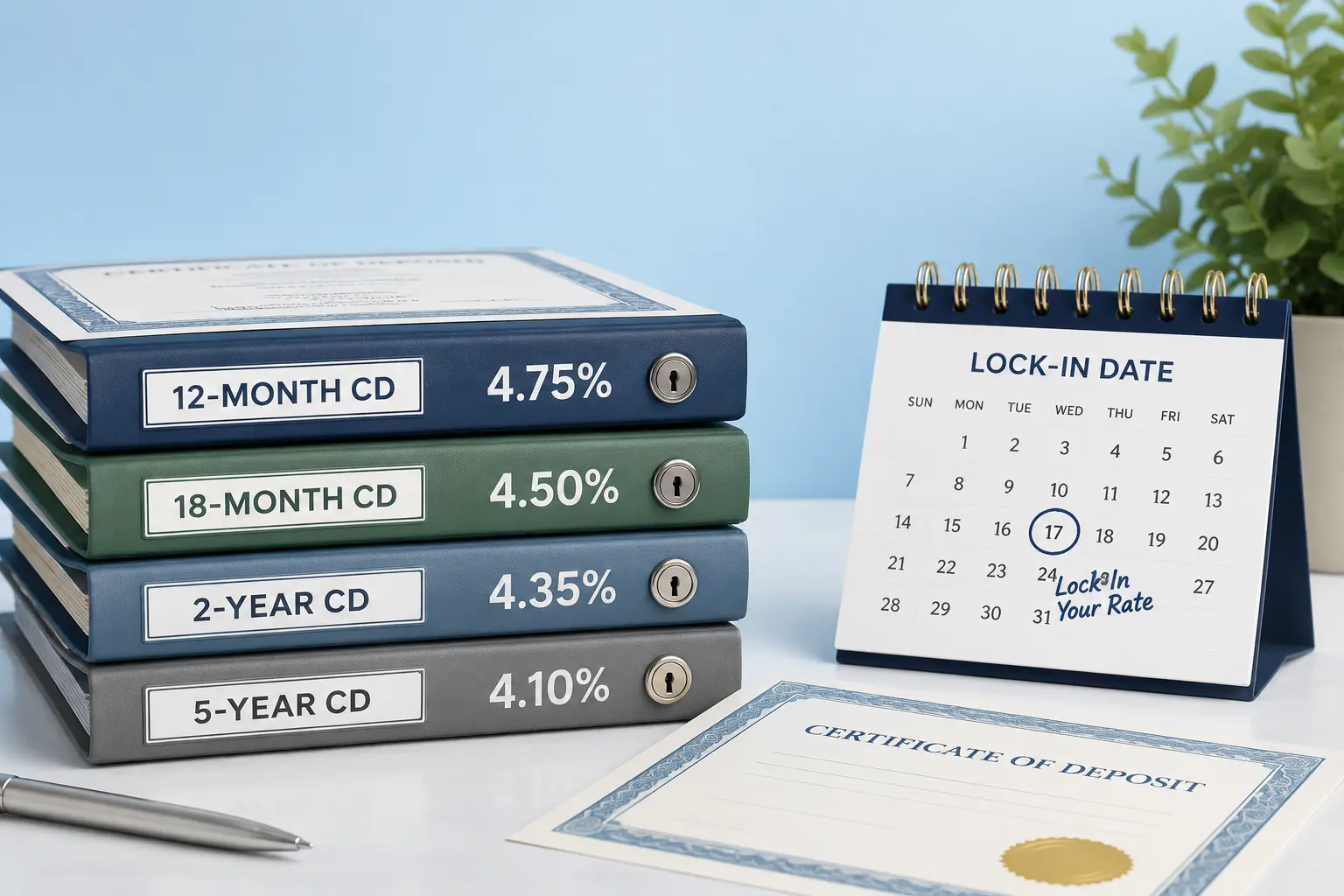 Personal Finance
 Best CD Rates 2026: Lock In 5%+ Before Rates Drop
We ranked the best CD rates of 2026 across 6 terms — 3-month to 5-year. CIT Bank leads at 5.10% APY. Full rate table, ladder strategy, and when NOT to use a CD.
 Personal Finance
 UFB Direct vs CIT Bank (2026): Which HYSA APY Is Highest?
Both have topped the online savings leaderboard all year. We compare current rates, account minimums, and the user experience to find the real winner.
 Personal Finance
 HYSA Welcome Bonuses 2026: How to Stack $500+ in Perks
Several online banks are offering $500-$1,000 welcome bonuses on top of 5%+ APY. Here's how to qualify and collect every dollar on offer.