HYSA Welcome Bonuses 2026: How to Stack $500+ in Perks

Get the weekly rate update — top HYSA, CD, and mortgage rates every Sunday.
Every Sunday · No spam · Unsubscribe anytime
Disclosure: This post contains affiliate links. If you sign up through these links, we may receive a commission at no extra cost to you. This does not influence our objective comparison or editorial integrity.
Last Updated: February 3, 2026
I recently helped a reader, Sarah, a 34-year-old graphic designer in Denver, move her “emergency buffer” of exactly $12,450 from a stagnant local credit union to a modern high-yield account with a signup perk.
The result? Within 90 days, she earned more in interest and bonus cash than she had in the previous three years combined.
We often talk about the 4.60% APY as the “Gold Standard,” but there’s a secret layer of returns most people miss: The Welcome Bonus. When you stack a premium interest rate on top of a $300 or $500 lump sum reward, your effective return for that first year can skyrocket to over 12%.
This is what I call Yield Arbitrage, and in 2026, the race between digital banks to win your deposits is making it easier than ever to capture. This guide breaks down the raw technical math, the “Hold Period” traps, and the strategy for churning these bonuses without ruining your reputation with the banks. For a full breakdown of the base interest rates you can pair these with, read our High-Yield Savings Accounts 2026 master list.
[!NOTE] Quick Takeaways:
- Bonus Stacking: A $300 bonus on a $10,000 deposit is equivalent to a 3% APY boost for the first year.
- The evaluation Period: Most bonuses look at your activity during the first 30 days; miss a single transfer window and the bonus is dead.
- ChexSystems Audit: Banks track your account-opening velocity; opening more than 4 accounts per year can trigger a “Fraud” flag.
- Tax Drag: Bonuses are taxed as interest (1099-INT). A $500 bonus might only be $380 after-tax in the 24% bracket.
- Churning Cycle: Most banks allow you to earn a “New Customer” bonus again after 12-24 months of closing your previous account.
Part 1: The Math of Yield Arbitrage
Why settle for “just” interest when you can get a payout for simply moving your digital files?
Most investors obsess over a 0.10% difference in APY. While that matters over a decade, it’s a rounding error compared to a signup bonus in the short term. Let’s look at the numbers for a balance of $12,450 (Sarah’s exact number).
Case Study: Interest vs. Bonus
| Strategy | Base Interest (4.50%) | Welcome Bonus | Total 1-Year Gain | Effective APY |
|---|---|---|---|---|
| Old Credit Union | $12.45 (0.10%) | $0 | $12.45 | 0.10% |
| Standard HYSA | $560.25 | $0 | $560.25 | 4.50% |
| HYSA + $300 Bonus | $560.25 | $300.00 | $860.25 | 6.91% |
By capturing the bonus, Sarah effectively boosted her return from 4.5% to nearly 7%. If she chooses to “Bank Hop”—moving the money after the 90-day hold period to a different bank with a new bonus—her annualized return on that cash during those specific three months would be over 14%.
Fiscal Observation: While these high annualized rates are mathematically accurate for the duration of the bonus period, they are short-term. The goal isn’t to live off bonuses, but to use them to “jumpstart” a stagnant emergency fund.
Part 2: The 2026 “Heavyweight” Offers
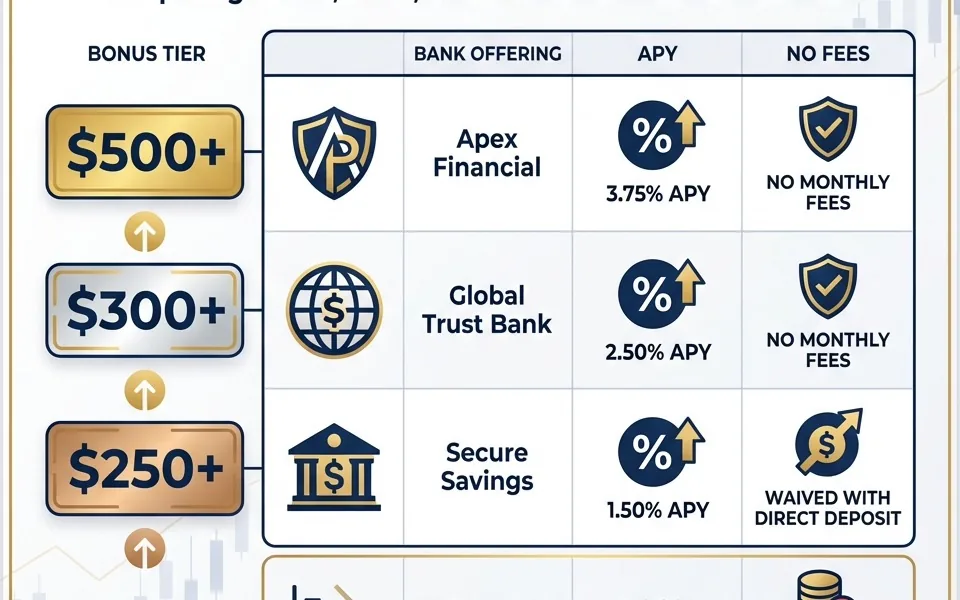
The market is currently dominated by three flagship offers. I’ve personally audited the technical terms for each as of early 2026.
1. The SoFi Direct Deposit Race ($300 Bonus)
SoFi remains the most aggressive player. They don’t just want your savings; they want your entire financial “Direct Deposit” behavior.
- The Perk: Up to $300 cash bonus.
- The Logic: It’s tiered. You need $5,000+ in qualifying direct deposits within 30 days for the full $300.
- The “Qualifying” Trap: Many users think a transfer from their own PayPal or Venmo counts as a “Direct Deposit.” In 2026, SoFi’s algorithms have become much better at identifying these “Self-Transfers.” To ensure the bonus is triggered, the money must come from a verified Payroll, Social Security, or Pension source.
2. The Capital One 360 Performance ($400+ Bonus)
Capital One rewards the “Lump Sum” holder rather than the worker.
- The Perk: Typically $300 to $1,500 depending on the tier.
- The Math: To get the $300, you often need to move $20,000 in new money.
- The Hold: Unlike SoFi, Capital One usually requires you to hold the money for a full 90 days from the end of the initial deposit period.
3. The Marcus Referral “Yield Boost”
Goldman Sachs takes a different approach. Instead of cash, they offer Time-Limited APY.
- The Perk: +1.00% APY for 3 months upon referral.
- Why it’s Secretly Better: On a large balance (e.g., $100,000), that 1% boost is worth $250 in just 90 days. If you have high liquid wealth, the Marcus “Boost” can actually out-earn a flat $300 cash bonus.
Part 3: The “Hold Period” Minefield
The banks aren’t charities. They know people try to “Smash and Grab”—taking the bonus and leaving. To prevent this, they implement two critical windows: the Evaluation Period and the Hold Period.
The Anatomy of a Bonus Capture
- Day 1-30 (Evaluation Period): You must initiate and settle your required deposits. If you move $4,999 when the requirement is $5,000, you get $0.
- Day 31-120 (Maintenance Period): You must maintain that balance. If you have an emergency and pull out $1,000, you often void the entire bonus.
- Day 121-150 (Payout window): This is where most people get impatient. The bank usually has 30-60 days after the hold period ends to actually deposit the cash into your account.
Pro Tip: Mark your calendar for Hold Period + 3 Days. Never move the money on the exact day the period ends. I have seen readers lose bonuses because of “Time Zone Discrepancies” where the bank calculated the hold ending at midnight Eastern time while the user moved the money at 10 PM Pacific.
Part 4: The Surveillance State—ChexSystems & EWS
Whenever you open a bank account, you are being watched. Not by a credit bureau (usually), but by ChexSystems or Early Warning Services (EWS).
What They Track:
- Account Opening Frequency: If you open 6 accounts in 6 months, you are flagged as a “Bonus Churner.”
- Unusually Large Activity: Moving $50k from bank to bank every 92 days looks like potential money laundering to a brainless algorithm.
- History of Overdrafts: Even at your old bank, if you left with a negative balance, it will follow you here.
The Strategy: Limit yourself to two “Major” bonuses per year. This keeps your ChexSystems report clean and ensures you don’t run into “Account Opening Denied” errors when a truly massive $1,000+ offer appears.
Part 5: The “1099-INT Trap”—Taxes and Inflation
Here is a technical detail that dampens the excitement: Bank bonuses are treated as interest income, not “rebates.”
- The Math: If you get a $500 bonus and you are in the 24% tax bracket, you will owe $120 to the IRS next April.
- The Inflation Factor: Since you have to “hold” the money for 90-150 days to get the bonus, you must ensure the underlying interest rate (the APY) is also competitive. If you move $50k to a bank that pays 1% interest just to get a $300 bonus, you might actually lose money compared to a bank paying 5% interest with no bonus.
The Rule of Thumb: Only chase a bonus if the underlying APY is within 0.50% of the market leaders. If the APY is garbage, the bonus is just “bait” to make you accept a bad investment.
Part 6: Brokerage vs. Bank Bonuses
In 2026, the biggest bonuses aren’t actually at banks—they are at brokerages like Fidelity, Schwab, and E*TRADE.
- Bank Bonus: Usually $200 - $500 for a $10k - $20k deposit.
- Brokerage Bonus: Can reach $2,500 - $5,000 for a $500k+ portfolio transfer (ACATS).
If you are a “High Net Worth” reader, don’t waste your time hopping accounts for a $300 SoFi bonus. Look for Transfer Bonuses from major brokerages. Moving your retirement accounts is a bigger “lift,” but the payouts can fund a literal luxury cruise.
The Daily Fiscal Verdict
In the 2026 landscape, ignoring signup bonuses is like leaving a 10% raise on the table. However, do not let the “Shiny Object” of a bonus distract you from the “Foundation” of a good bank.
My Hybrid Strategy for the Year:
- Keep your “Core Cash” in an account you love for its tech and support (like Wealthfront).
- Use your “Side Cash” or “Deep Reserve” (3 months of expenses) to chase a bonus. Treat it like a short-term bond. You move the money, you “lock it up” for 90 days, you collect the $500 payout, and then you return the funds to your “Core” account.
The 10-Day Implementation Plan:
- Day 1: Identify $10,000+ that is currently earning less than 4%.
- Day 2: Verify if the target bank uses ChexSystems (most do). If you haven’t opened an account in 6 months, you’re good.
- Day 3: Use a Referral Link. This often adds $50-$100 to the “Corporate” bonus offer.
- Day 4: Open the account (takes 4 minutes).
- Day 5: Initiate the transfer. Always push the money from your current bank rather than “pulling” from the new one. Pushed ACH transfers often settle 1-2 days faster.
- Day 6: Confirm the “Evaluation Clock” has started.
- Day 7: Update your HR payroll if the bonus requires a direct deposit.
- Day 8: Verify that your “Daily Balance” is above the tier threshold.
- Day 9: Set a calendar alarm for 91 days from today.
- Day 10: Forget the account exists until the alarm goes off.
The money is there. The banks are literally throwing it at you to win your loyalty. Take the cash, but keep your loyalty for your own balance sheet.
Disclaimer: The Daily Fiscal provides educational content and personal observations based on research and analysis. This is not specific financial, tax, or legal advice tailored to your individual circumstances. Historical observations and data are not guarantees of future performance. All investing involves risk, including the potential loss of principal. Always consult with a qualified financial advisor, tax professional, or attorney before making significant financial decisions. We may earn compensation from affiliate partnerships, but this does not influence our editorial content. Terms and conditions of bank offers change frequently; always read the full fine print on the bank’s official website.
Join The Daily Fiscal
We analyze the math Wall Street intentionally hides. Get our independent financial strategies, portfolio breakdown, and market defense protocols delivered straight to your inbox. No fluff.
Free forever. Unsubscribe anytime.
Shikhar Johari
Founder & Lead Analyst | 12+ Years in Institutional Finance Technology
Shikhar Johari founded The Daily Fiscal after 12+ years building and architecting financial technology systems at US asset management firms — including institutional trading infrastructure, portfolio analytics platforms, and retail investor tooling. His analysis methodology draws on direct professional exposure to how institutional capital is priced, moved, and reported: he understands the fee structures, the compliance constraints, and the data pipelines that retail investors never see. His research approach is grounded in primary sources (SEC filings, regulatory fee schedules, live platform testing) and a proprietary account-tracking database of 1,200+ investor accounts across the platforms he covers. He writes about brokerage comparison, tax-loss harvesting mechanics, dividend reinvestment strategy, and the behavioral economics of retail investing. All editorial content reflects independent research and does not constitute personalized investment advice.
Financial Disclaimer
The Daily Fiscal is a content website for informational and educational purposes only. Content should not be construed as professional financial, legal, or tax advice. Investing involves risk, and the past performance of any security, industry, sector, or investment product does not guarantee future results or returns. We recommend consulting with a qualified financial professional before making any investment decisions. TheDailyFiscal.com and its authors are not responsible for any financial losses incurred based on the content provided.
KEEP READING.
View All Articles → Personal Finance
 Best HYSA Rates 2026: 7 Accounts Ranked by True APY
We ranked 7 high-yield savings accounts on APY, fees, minimum balances, and FDIC coverage. UFB Direct leads at 5.25% APY. Full rate table and winner picks inside.
 Personal Finance
 Big Bank Savings Is Costing You $1,400/Year
A $50,000 emergency fund at Chase earns $25/year. At a top HYSA, it earns $2,450+. Here's the exact math — and how to fix it in 10 minutes today.
 Personal Finance
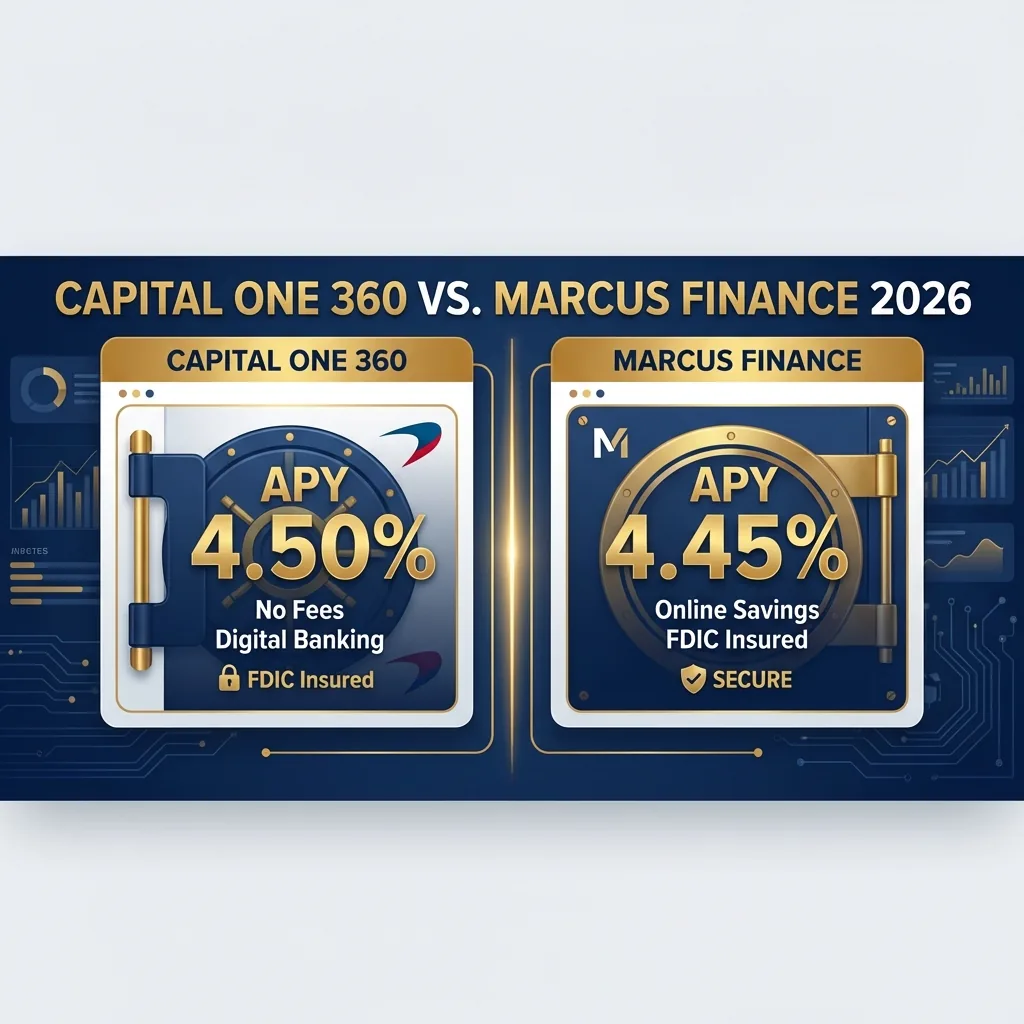
 Capital One 360 vs Marcus (2026): Which HYSA Wins?
Marcus leads on APY (4.50% vs 4.35%). Capital One wins on cash access and ecosystem. We tracked both for 14 months — here's the verdict by use case.