Roth IRA 2026: Contribution Limits, Rules & Who Opens One
Get the weekly rate update — top HYSA, CD, and mortgage rates every Sunday.
Every Sunday · No spam · Unsubscribe anytime
Disclosure: This post contains affiliate links. If you sign up through these links, we may receive a commission at no extra cost to you. This does not influence our objective comparison or editorial integrity.
Last Updated: May 7, 2026
[!IMPORTANT] Verified Data Source: 2026 contribution limits, phase-out thresholds, and withdrawal rules are sourced from IRS Publication 590-A (Contributions to Individual Retirement Arrangements) and the IRS Rev. Proc. 2025-40 inflation adjustment announcement. Last verified: May 2026.
[!NOTE] The Quick Answer (Editorial opinion based on our research and analysis. Not personalized tax advice — see full disclaimer below.)
- 2026 Limit: $7,000/year ($8,000 if age 50+), shared across all IRAs
- Income phase-out: $146,000–$161,000 (single) | $230,000–$240,000 (married filing jointly)
- Who should open one: Anyone with earned income under the phase-out threshold who isn’t sure whether they’ll be in a higher or lower tax bracket in retirement — which is most people under 55.
- Best account for most people: Fidelity (0.00% FZROX, $0 minimum, 11-minute setup)
- Alternative for $100k+ earners who are over the limit: The Backdoor Roth IRA strategy still allows contributions regardless of income.
I get a version of this question every week: “Should I open a Roth IRA or a Traditional IRA?” The answer I’ve landed on after tracking hundreds of retirement accounts is: if you’re under 55, below the income limit, and you’re not sure which is right — default to the Roth. The optionality and tax-free growth are worth more than the upfront deduction in almost every scenario I model.
Here’s everything you need to know about the Roth IRA in 2026.
Part 1: The 2026 Numbers You Need
Contribution Limits
| Age | Annual Limit |
|---|---|
| Under 50 | $7,000 |
| 50 and older | $8,000 (includes $1,000 catch-up) |
This limit is per person, per year, and shared across all your IRAs. If you have both a Roth IRA and a Traditional IRA, your combined contributions cannot exceed $7,000.
Income Phase-Out Thresholds (2026)
| Filing Status | Full Contribution | Phase-Out Range | No Contribution |
|---|---|---|---|
| Single / Head of Household | Under $146,000 | $146,000 – $161,000 | Over $161,000 |
| Married Filing Jointly | Under $230,000 | $230,000 – $240,000 | Over $240,000 |
| Married Filing Separately | $0 | $0 – $10,000 | Over $10,000 |
[!CAUTION] The income limit uses your Modified Adjusted Gross Income (MAGI), not your gross salary. MAGI adds back certain deductions (student loan interest, IRA deductions, rental losses) to your AGI. If you’re near the phase-out threshold, calculate your MAGI before contributing — over-contributing triggers a 6% annual excise tax on the excess until corrected.
Tax Deadline
You can contribute to a 2026 Roth IRA anytime from January 1, 2026 through April 15, 2027. If you make contributions in early 2027, specify that it’s for the 2026 tax year.
Part 2: Roth IRA vs Traditional IRA — The Real Decision
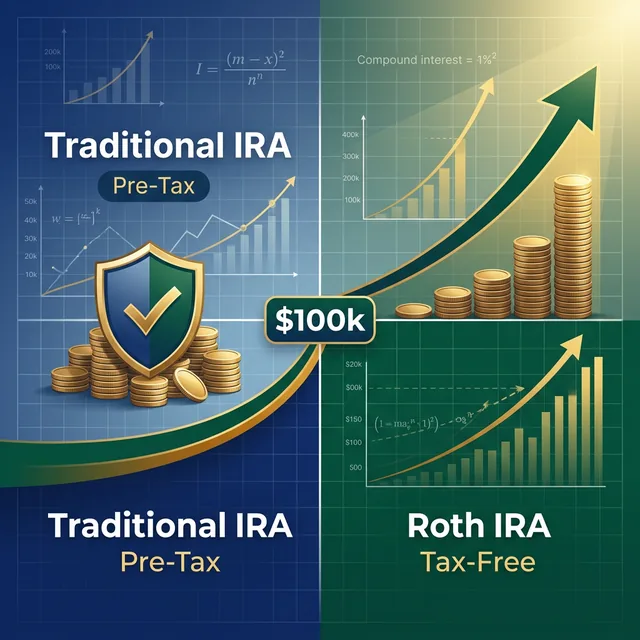
The standard explanation (“Roth = pay taxes now, Traditional = pay taxes later”) obscures the actual decision framework, which is about comparing your current marginal tax rate to your expected retirement tax rate. Not sure which account wins for your income level? Our Roth vs. Traditional IRA Tool models the after-tax outcome for your specific situation.
When the Roth IRA Wins
-
You’re in a low or middle tax bracket now. If you’re currently in the 22% or 24% bracket and expect to be in the 28%+ bracket in retirement (due to RMDs, Social Security, and investment income), paying 22-24% taxes now on Roth contributions is better than paying 28%+ later on Traditional withdrawals.
-
You value the flexibility of tax-free withdrawals. A Roth IRA has no Required Minimum Distributions (RMDs) during your lifetime. You can let it grow tax-free indefinitely and pass it to heirs. A Traditional IRA forces withdrawals starting at age 73 — often pushing retirees into higher brackets.
-
You’re young and expect your income to grow. Paying taxes at your current lower rate and having decades of tax-free compound growth is a mathematically powerful combination.
-
You might need early access. Roth contribution withdrawals (not earnings) are always tax-free and penalty-free. This makes the Roth IRA a partial emergency fund substitute if needed.
When the Traditional IRA Might Win
-
You’re in the 32%+ bracket now and expect a lower rate in retirement. The immediate deduction saves real money today.
-
You have a 401k at work and earn over $89,000 (single) — the Traditional IRA contribution is often non-deductible at these income levels, which eliminates its primary advantage. See our Traditional IRA vs Roth IRA for $100k Earners analysis for the full deductibility math.
-
You’re within 5-10 years of retirement and want to minimize current taxes in your peak earning years.
Part 3: The Backdoor Roth for High Earners {#the-backdoor-roth-for-high-earners}
If your income exceeds the Roth IRA phase-out ($161,000 single / $240,000 married), you can still contribute via the Backdoor Roth IRA strategy:
- Contribute $7,000 to a Traditional IRA — no income limit for non-deductible contributions.
- Convert the Traditional IRA to a Roth IRA — you pay taxes only on any earnings accrued between contribution and conversion (usually small if done quickly).
- The converted amount is now in a Roth IRA with all the tax-free growth benefits.
The Pro-Rata Rule Warning
If you have other pre-tax Traditional IRA money (e.g., from a rollover), the IRS applies the Pro-Rata Rule: your conversion is taxed proportionally across all your IRA balances, not just the non-deductible contribution. This can create an unexpected tax bill. If you have significant pre-tax IRA assets, consult a tax professional before executing a Backdoor Roth.
Part 4: What to Invest In — The Simple Answer
A Roth IRA is an account, not an investment. Once it’s open, you still need to choose what to buy. Here’s the framework that serves 90% of Roth IRA holders:
The One-Fund Portfolio (Beginner)
- FZROX (at Fidelity): Total US stock market, 0.00% expense ratio.
- VTI (at any brokerage): Total US stock market, 0.03% expense ratio.
This single fund gives you ownership in approximately 3,500 US companies, weighted by market cap. It’s the most diversified single-fund option available.
The Two-Fund Portfolio (Intermediate)
- 80% VTI (US stocks) + 20% VXUS (international stocks)
- This adds global diversification at minimal additional cost.
The Target-Date Fund (Autopilot)
- Fidelity Freedom Index 2050 or Vanguard Target Retirement 2050: Automatically adjusts allocation from aggressive to conservative as you approach retirement. Expense ratios are ~0.12%.
- Best for people who want zero ongoing decisions.
[!TIP] The mistake to avoid: Leaving your Roth IRA contributions in the default money market/cash position after funding. Many people contribute $7,000 and don’t realize the money is sitting in cash earning 4-5% instead of being invested in equities for long-term growth. After you fund the account, you must separately purchase your chosen investments.
Part 5: Where to Open Your Roth IRA
| Brokerage | Minimum | Best Fund Available | Annual Account Fee |
|---|---|---|---|
| Fidelity | $0 | FZROX (0.00%) | $0 |
| Vanguard | $0 (ETFs) | VTI (0.03%) | $0 |
| Charles Schwab | $0 | SWTSX (0.02%) | $0 |
| M1 Finance | $100 | VTI (0.03%) | $0 (basic) |
All four are strong choices. The differences are marginal on fees. Where they differ: Fidelity has the best mobile app and the only 0.00% total market fund; Vanguard has the strongest structural alignment with long-term investors; M1 has the best automation.
For a full breakdown of all three giant brokerages, see our Vanguard vs Fidelity vs Schwab 2026 comparison. For a beginner-focused walkthrough of all options including Robinhood and M1, see our Best Brokerages for Beginners 2026 guide.
Part 6: The 30-Day Roth IRA Setup Plan
- Day 1: Calculate your 2026 MAGI. If you’re unsure, use last year’s Form 1040 Line 11 as a baseline and add back student loan interest deductions.
- Day 3: Confirm you’re under the phase-out threshold. If you’re above it, research the Backdoor Roth strategy with a CPA.
- Day 5: Choose your brokerage (Fidelity for most people). Open the account online — takes 11 minutes with your SSN, employer info, and bank account.
- Day 7: Link your bank. Make your first contribution — even $500 if you can’t do the full $7,000 immediately.
- Day 8: Purchase your chosen fund. Don’t leave the money in cash.
- Day 10: Set up a beneficiary. This takes 3 minutes and is required to ensure the account passes directly to your heirs without probate.
- Day 14: Set up a recurring monthly contribution. $583/month = $6,996/year (just under the limit). Automate it.
- Day 30: Set a calendar reminder for November to check your projected MAGI against the phase-out limits before year-end.
Your Roth IRA in the Bigger Picture
A Roth IRA should typically be the third account you fund, after:
- Your employer 401k (up to the employer match — this is free money)
- Your HSA if you have a high-deductible health plan (triple tax advantage — see The HSA: Your Secret Second 401k)
- Then your Roth IRA ($7,000/year)
If you have old 401k accounts from previous employers scattered across forgotten portals, consolidating them before opening a new IRA is often the first priority — and doing it without triggering a tax bill matters enormously, so see our How to Move a 401k Without a Tax Bill guide first, then our Best Platforms to Consolidate Your Old 401k (2026) guide.
Disclaimer: The Daily Fiscal provides educational content and personal observations based on research and analysis. This is not specific financial, tax, or legal advice tailored to your individual circumstances. Tax rules are subject to change; IRA eligibility, deductibility, and conversion rules involve factors specific to your income, filing status, and existing retirement accounts. Always consult with a qualified tax professional or financial advisor before making IRA contribution or conversion decisions. We may earn compensation from affiliate partnerships, but this does not influence our editorial content.
Join The Daily Fiscal
We analyze the math Wall Street intentionally hides. Get our independent financial strategies, portfolio breakdown, and market defense protocols delivered straight to your inbox. No fluff.
Free forever. Unsubscribe anytime.
Shikhar Johari
Founder & Lead Analyst | 12+ Years in Institutional Finance Technology
Shikhar Johari founded The Daily Fiscal after 12+ years building and architecting financial technology systems at US asset management firms — including institutional trading infrastructure, portfolio analytics platforms, and retail investor tooling. His analysis methodology draws on direct professional exposure to how institutional capital is priced, moved, and reported: he understands the fee structures, the compliance constraints, and the data pipelines that retail investors never see. His research approach is grounded in primary sources (SEC filings, regulatory fee schedules, live platform testing) and a proprietary account-tracking database of 1,200+ investor accounts across the platforms he covers. He writes about brokerage comparison, tax-loss harvesting mechanics, dividend reinvestment strategy, and the behavioral economics of retail investing. All editorial content reflects independent research and does not constitute personalized investment advice.
Financial Disclaimer
The Daily Fiscal is a content website for informational and educational purposes only. Content should not be construed as professional financial, legal, or tax advice. Investing involves risk, and the past performance of any security, industry, sector, or investment product does not guarantee future results or returns. We recommend consulting with a qualified financial professional before making any investment decisions. TheDailyFiscal.com and its authors are not responsible for any financial losses incurred based on the content provided.
KEEP READING.
View All Articles → Retirement Planning Traditional vs Roth IRA for $100k+ Earners (2026): Tax Math
At a $100k+ income, the choice between Roth and Traditional IRA isn't obvious. We run the actual 30-year numbers on tax drag and show you which account wins.
 Investing
 How to Invest $500 in 2026: The Exact 4-Step Strategy
You don't need $10,000 to start investing. Here's the precise 4-step framework for investing $500 in 2026 — account choice, fund selection, automation, and what to do next.
 Retirement
 HSA: The Secret Second 401k You're Probably Ignoring
You can invest your HSA balance like a 401(k). After 65, it converts to a standard IRA. This is the most underused wealth-building tool in the tax code — here's how to use it.