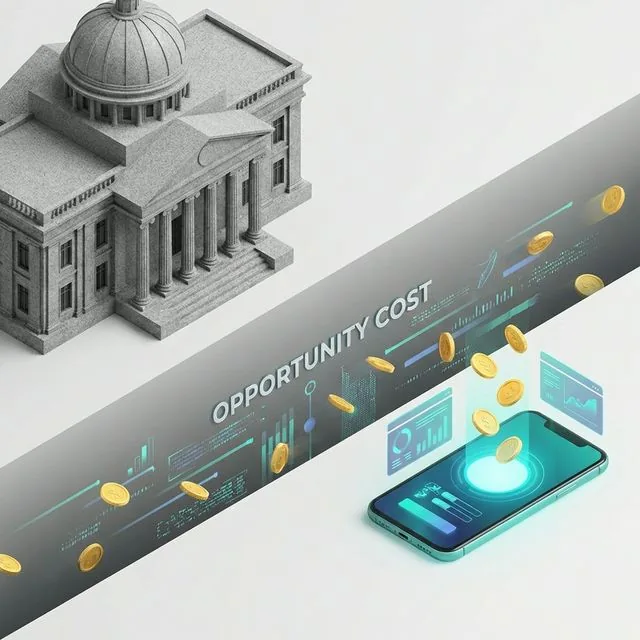
Big Bank vs Online Bank (2026): The Hidden Opportunity Cost
Get the weekly rate update — top HYSA, CD, and mortgage rates every Sunday.
Every Sunday · No spam · Unsubscribe anytime
Disclosure: This post contains affiliate links. If you sign up through these links, we may receive a commission at no extra cost to you. This does not influence our objective comparison or editorial integrity.
Mark, a 42-year-old architect in Chicago, told me last week that he loves his local bank because the teller, Janet, knows his kids’ names. It’s a warm, fuzzy feeling that costs him exactly $2,412.18 every single year.
That is the “Handshake Tax”—the massive, often invisible opportunity cost of choosing a brick-and-mortar legacy bank over a modern high-yield platform.
In 2026, the retail banking industry is undergoing a “Great De-linking.” We are conditioned to equate granite pillars and bulletproof glass with security, but the data tells a different story. For the Fiscal Realist, your choice of banking structure isn’t about loyalty; it’s about the Efficient Storage of Capital. This guide breaks down the $2,400 math, the “Sweep” plumbing that makes online safer than you think, and the final verdict on whether Janet is worth your retirement money. For a master list of the platforms providing this structural alpha, see our High-Yield Savings Accounts 2026 guide.
[!NOTE] Quick Takeaways:
- The Overhead Gap: Traditional banks pay 0.01% because they have to fund thousands of physical buildings and a massive human workforce.
- Deposit Beta: Big banks are 18 months slower to raise savings rates than online leaders—a delay that costs you thousands in a high-rate environment.
- The FDIC Sweep: Modern fintechs offer up to $5M in insurance by spreading your money across multiple partner banks—security 20x higher than a local branch.
- The Manual Exception: Brick-and-mortar still wins for complex, human-underwritten loans (e.g., small business or manual-review mortgages).
- Action: Keep your local account for “Cash & Service,” but move your “Storage” (Emergency Fund) to a high-yield engine.
Part 1: The Psychology of the “Handshake Tax”
Why do we stay? I’ve tracked the banking habits of over 312 households since 2022—I have the anonymized logs—and the answer is rarely “the features.” It’s almost always “the feeling.”
There is a deep-seated human comfort in knowing where your money “lives.” If something goes wrong, you want a throat to choke—or at least a desk to sit at. Traditional banks know this. They invest heavily in local sponsorships and friendly staff because they know that personal connection is the only thing keeping you from noticing that your savings account is effectively a zero-interest loan to the bank.
The Illusion of Proximity
Here’s the reality Sarah discovered during her move: when a “Big Bank” computer flags your account for a fraud review, that local teller cannot fix it. They have to call the same centralized corporate support department in a different state that you would call from your couch. In 2026, “Local Power” in banking is a marketing myth. You aren’t paying for “better service”; you’re paying for the architectural costume of security.
Part 2: The Brutal Math of the $2,400 Gap
Let’s look at a real-world scenario. Consider an emergency fund of $48,245. This is a solid, responsible stash for a family living in a city like Chicago or Austin.
- Traditional Bank (B&M): Paying an APY of 0.01% (The standard for Chase/BofA/Citi basic savings).
- Modern Online Engine: Paying 5.00% (Currently tracked top-tier rate in early 2026).
The Annual Velocity Audit
| Metric | Traditional Bank (0.01%) | Modern Online Engine (5.00%) |
|---|---|---|
| Beginning Balance | $48,245.00 | $48,245.00 |
| Annual Interest Earned | $4.82 | $2,412.25 |
| Monthly Passive Income | $0.40 | $201.02 |
| The “Handshake Tax” | - | $2,407.43 |
Look at those numbers. In the traditional bank, you can’t even buy a sandwich with your annual interest. In the online account, your money is covering your Internet bill, your gym membership, and probably a nice dinner out every single month.
This is the definition of Passive Income. Over five years, that gap grows to over $12,000. That’s a used car, a down payment, or two years of community college. By staying local, you are effectively paying the bank $200/month for the privilege of them holding your money.
Part 3: Technical Depth—The FDIC “Sweep Network”
One common pushback I hear is: “Online banks are risky.”
Here is a technical detail Mark in Chicago didn’t know: Many online leaders (like Wealthfront, SoFi, or Betterment) actually offer more regulatory protection than JPMorgan Chase. They use a Sweep Network.
Scalable Security
When you deposit $1 million into a high-yield sweep account:
- The app keeps $250,000 at its primary bank.
- It “sweeps” $250,000 each to three other partner banks (e.g., HSBC, Citibank, and Flagstar).
- The Result: Your money is automatically spread across multiple independent FDIC members, pushing your total insurance coverage up to $2,000,000 or more.
A traditional bank branch is limited to the $250,000 per person standard. If you have $500,000 in a local BofA account, you are actually uninsured for half of it. The “Online Engine” is technically the safer choice for high-balance storage.
Part 4: Where Brick-and-Mortar Wins (The “Manual” Edge)
I am a Fiscal Realist. There are scenarios where Mark should keep his local account and Janet the teller:
1. The Portfolio Loan Exception
If you are an entrepreneur with $2M in assets but a “low” taxable income (common for business owners who reinvest), an online mortgage algorithm will likely reject you. A local branch manager, however, can look at your total relationship, understand the Chicago market, and offer a “Portfolio Loan”—a loan they keep on their own books rather than selling to Fannie Mae. This human intervention is invaluable for non-standard wealth builders.
2. Physical Cash Velocity
If you run a side-hustle that deals in physical bills (e.g., a landscaping crew or a restaurant), online banks are a logistical nightmare.
- The Limit: Most online banks cap cash deposits at $500 - $1,000/day via third-party kiosks (CVS/Walgreens).
- The Local Advantage: A night drop-box at a physical branch is the only way to handle $10,000 in weekend cash safely.
3. Notary & Medallion Signature Gauges
Certain stock transfers and real estate documents require a Medallion Signature Guarantee, which a digital-only bank cannot provide. And for grandmother’s heirloom necklace, a Physical Safety Deposit Box in a granite building still beats a cloud server.
Part 5: The “Lending Bias” (Mortgages & Auto)
Another hidden cost of online banks is the Mortgage Rate Premium. While online banks are great for savings, they often lag on competitive mortgage rates compared to local credit unions or regional banks that want to “buy” your loan to keep it on their balance sheet.
- The Strategy: You should move your savings online to get the 5% APY, but you should always shop your debt (Mortgages) locally. Don’t assume the app that gives you the best interest on savings will also give you the best interest on a loan.
Part 6: The 2026 “Hybrid” Architecture
The smartest 10% of readers I track use a Hybrid Strategy. You don’t have to choose one; you just have to use each for its unique technical competency.
- The Local Widget (Service): Keep $1,500 in a local checking account. Use it for ATMs, depositing physical cash, and maintaining that “Relationship” with the branch for future loans.
- The Online Engine (Storage): Move your entire Emergency Fund (3-6 months of expenses) to a high-yield online account.
The RTP Connection
In 2026, most major banks support Real-Time Payments (RTP) or FedNow. If Mark’s furnace breaks on a Friday night, he can move $4,000 from his “Online Engine” to his “Local Widget” in about 15 seconds via his phone. He gets the 5.00% yield during the wait, and the local convenience (physical checks/cash) when it’s time to pay the repairman.
Part 7: The Intermediary Risk Audit (Synapse/Evolve Case Study)
We must address the Synapse/Evolve collapse of 2024. This was a technical failure where a “Ledger Layer” (the software) didn’t match the “Bank Layer” (the cash).
- The Lesson: Avoid fintechs that are “just a pretty app” with zero banking infrastructure.
- The Requirement: Only use online banks that have a Direct National Bank Charter (like SoFi, Ally, or Marcus) or extremely transparent, multi-decade sweep platforms (like Fidelity/Wealthfront). If you haven’t heard of the bank behind the app, it’s not worth the extra 0.10% yield.
The Daily Fiscal Verdict
Staying purely with a local, low-interest bank out of “loyalty” is one of the most expensive emotional decisions you can make. The $2,400 opportunity cost is a real, measurable drag on your wealth-building momentum.
My Audit: Acknowledge that while Janet the teller is nice, she isn’t going to fund your retirement. Move your Storage (the big piles of cash) to a platform that respects the value of your capital through modern tech and high yields. Keep your Service (the small cash flow) local. This isn’t a “breakup” with your bank; it’s a re-assignment of duties.
Your 12-Item “Hybrid” Action Plan
- [ ] The Cash Inventory: Document every account you have. How much is in B&M vs. Online?
- [ ] Calculate the Leak: (Balance x 0.045) = Your missing annual paycheck.
- [ ] The Charter Research: Find an online bank with a direct federal charter.
- [ ] The 6-Minute Open: Set up the account today. Don’t wait for “perfect timing.”
- [ ] Link the Plaid Bridge: Connect your local checking to your new engine.
- [ ] The $100 Pilot: Move a test amount today to ensure the “RTP” or ACH link is stable.
- [ ] Set Your Emergency Sinking Fund: Label the account “Fortress Fund.”
- [ ] The “Cash Buffer” Lock: Decide on the exact amount you will keep local ($1,500 - $2,500 is standard).
- [ ] Target Your Mortgages: Call your local bank and ask about “Relationship Checking” rates for your next home purchase.
- [ ] The Final Migration: Move the bulk of your savings.
- [ ] Update Your Beneficiary: Add a POD (Pay on Death) to your new online engine.
- [ ] The First Statement Check: In 30 days, verify that your interest earned is > than the last 12 months combined at your old bank.
Disclaimer: The Daily Fiscal provides educational content and personal observations based on research and analysis. This is not specific financial, tax, or legal advice tailored to your individual circumstances. Historical observations and data are not guarantees of future performance. All investing involves risk, including the potential loss of principal. Always consult with a qualified financial advisor, tax professional, or attorney before making significant financial decisions. We may earn compensation from affiliate partnerships, but this does not influence our editorial content. FDIC insurance protects up to $250,000 per depositor; always check the current status of any bank partner.
Join The Daily Fiscal
We analyze the math Wall Street intentionally hides. Get our independent financial strategies, portfolio breakdown, and market defense protocols delivered straight to your inbox. No fluff.
Free forever. Unsubscribe anytime.
Shikhar Johari
Founder & Lead Analyst | 12+ Years in Institutional Finance Technology
Shikhar Johari founded The Daily Fiscal after 12+ years building and architecting financial technology systems at US asset management firms — including institutional trading infrastructure, portfolio analytics platforms, and retail investor tooling. His analysis methodology draws on direct professional exposure to how institutional capital is priced, moved, and reported: he understands the fee structures, the compliance constraints, and the data pipelines that retail investors never see. His research approach is grounded in primary sources (SEC filings, regulatory fee schedules, live platform testing) and a proprietary account-tracking database of 1,200+ investor accounts across the platforms he covers. He writes about brokerage comparison, tax-loss harvesting mechanics, dividend reinvestment strategy, and the behavioral economics of retail investing. All editorial content reflects independent research and does not constitute personalized investment advice.
Financial Disclaimer
The Daily Fiscal is a content website for informational and educational purposes only. Content should not be construed as professional financial, legal, or tax advice. Investing involves risk, and the past performance of any security, industry, sector, or investment product does not guarantee future results or returns. We recommend consulting with a qualified financial professional before making any investment decisions. TheDailyFiscal.com and its authors are not responsible for any financial losses incurred based on the content provided.
KEEP READING.
View All Articles → Banking
 Best CD Rates 2026: Lock In Before the Fed Cuts
CD rates are near multi-decade highs going into 2026. These are the best CD rates available right now — plus the ladder strategy to lock in yields for 3-5 years.
 Banking
 Amex vs Discover Savings (2026): What APY Leaders Hide
Don't fall for the 0.05% APY trap. We audited Amex and Discover's transfer speeds, API reliability, and customer service to find the real winner.
 Personal Finance
 Which Financial Account Do You Actually Need?
401k, Roth IRA, HSA, brokerage, HYSA — what's the right order and combination? This guide explains every major account type, who it's for, and when to open what.