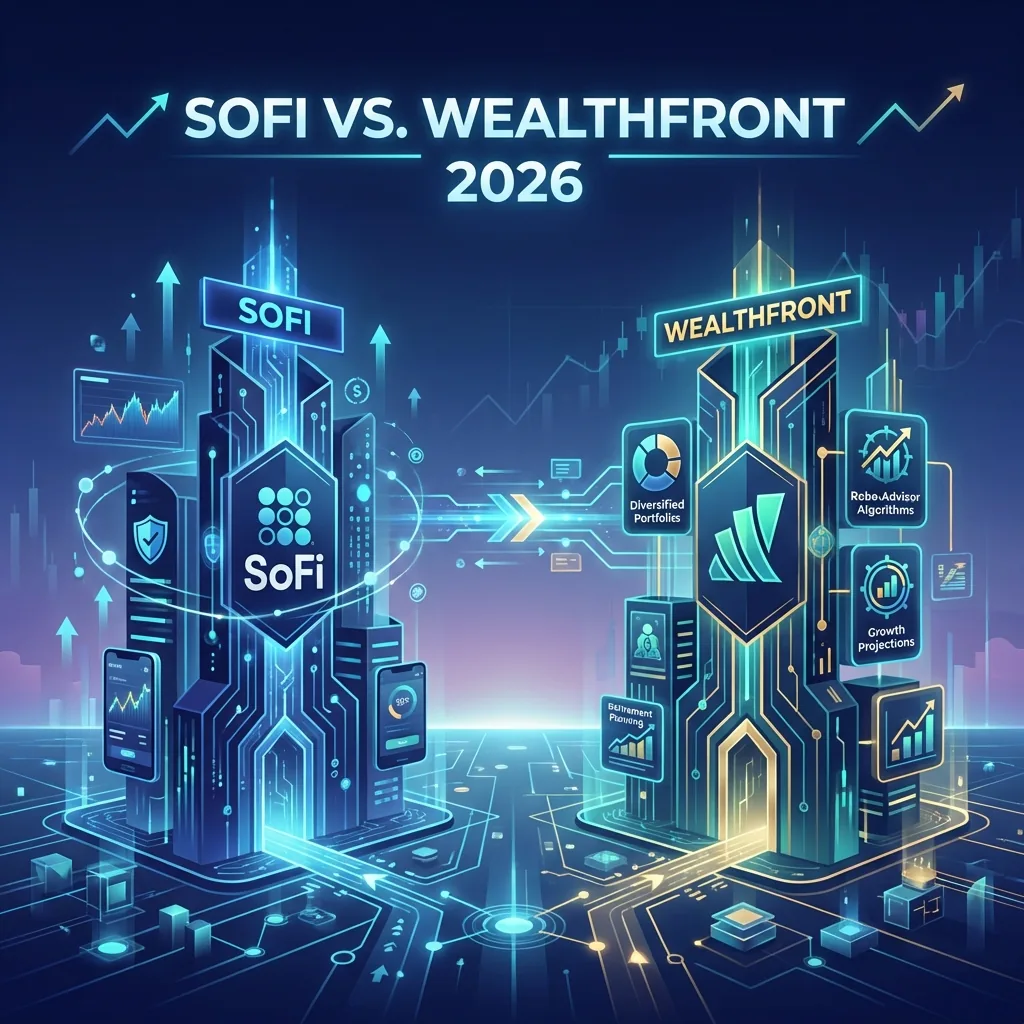
SoFi vs Wealthfront (2026): Cash + Investing in One Place?
Get the weekly rate update — top HYSA, CD, and mortgage rates every Sunday.
Every Sunday · No spam · Unsubscribe anytime
Disclosure: This post contains affiliate links. If you sign up through these links, we may receive a commission at no extra cost to you. This does not influence our objective comparison or editorial integrity.
Last Updated: January 29, 2026
After tracking the digital banking landscape for the last five years, I’ve realized one thing: the bank you choose for your first $10,000—or in this case, a very specific $9,847—can be the difference between “parking” your money and “propelling” it.
In 2026, we find ourselves in the “Golden Age of the Digital Fintech.” The traditional giants (Chase, Bank of America, Wells Fargo) are still paying 0.01% on savings because they have “Captive Audiences” who find switching too cognitively expensive. But for the Fiscal Realist, the only real choice is between a powerhouse banking ecosystem like SoFi or an engineering-led wealth engine like Wealthfront.
This guide breaks down the infrastructure of a “Chartered Bank” versus a “Sweep Brokerage,” the math of the tax-loss harvesting alpha, and the final word on where to park your first $9,847 for maximum terminal value. For a broader look at the market, see our High-Yield Savings Accounts 2026 master list.
[!NOTE] Quick Takeaways:
- Wealthfront leads for pure optimizers who want automated tax-loss harvesting and the highest possible FDIC coverage ($8M).
- SoFi wins for “all-in-one” users who want their paycheck, savings, and credit card in a single, high-speed interface.
- The Math: At currently tracked 2026 rates, the 0.40% spread between them means a difference of roughly $39.38 in annual interest on $9,847.
- Infrastructure: SoFi holds a direct bank charter; Wealthfront is a broker-dealer with a sweep network.
- The Verdict: Choose SoFi for the lifestyle ecosystem and upfront bonuses; choose Wealthfront for the math and long-term capital efficiency.
Part 1: The Infrastructure Truth (Bank vs. Broker)
Before we look at interest rates, we have to talk about the “Plumbing.” This is a technical distinction that most beginners don’t realize until they try to wire $40,000 for a home down payment or a complex international purchase.
SoFi is a Direct Bank
In 2022, SoFi acquired Golden Pacific Bancorp, giving them a national bank charter. When you put money in SoFi, it sits directly on their balance sheet, protected by their direct FDIC insurance ($250,000).
- The Plus: One institutional relationship. One ledger. One regulatory oversight body (the OCC).
- The Access: Because they are a bank, they offer traditional features like paper checks, official bank letters (necessary for house closings), and direct, native Zelle integration.
Wealthfront is a Broker-Dealer
Wealthfront is technically an investment firm. When you put money in their “Cash Account,” they use a proprietary Brokerage Sweep Engine to “sweep” your money to a network of partner banks (e.g., Citibank, HSBC, Truist).
- The Plus: Because they use multiple banks, they can offer up to $8 million in FDIC insurance. They essentially “ladder” your deposits across 32 different institutions.
- The Catch: You are technically a “General Creditor” of the sweep layer for the first 24 hours until the money settles. They also do not provide traditional bank letters for mortgage underwriting as easily as SoFi.
Part 2: The SoFi Ecosystem (The Efficiency Loop)
SoFi’s strategy is simple: they want to be your “One-Stop Shop.” Their app is busy—bordering on cluttered—but the “Circular Rewards” model is genius for behavioral efficiency.
The Direct Deposit Hook
SoFi’s 4.60% APY is their premium tier. To unlock it, you need a recurring direct deposit. But once you do, you unlock SoFi Points. Every time you log in, check your credit score, or pay a bill via their portal, you earn points that can be redeemed for cash or used to buy Bitcoin or NVIDIA fractional shares within the same app.
The “Vaults” Psychology
SoFi’s Vaults feature is the best behavioral tool in banking. You can segregate your $9,847 into “Emergency,” “New Car,” and “Christmas 2026.” While these are technically all in one account earning the same interest, the “Mental Accounting” prevents you from spending your emergency fund on a new television.
Part 3: The Wealthfront Edge (The Engineer’s Vault)
Wealthfront doesn’t care about your “lifestyle” or your points. They care about the Net Internal Rate of Return (IRR). Their interface is the “Apple” to SoFi’s “Android”—sleek, minimal, and driven by algorithms.
The “Tax Alpha” Secret (Direct Indexing)
If your $9,847 grows into a larger portfolio (over $100,000), Wealthfront offers Direct Indexing. Instead of just buying an S&P 500 ETF (like VOO), they buy all 500 individual stocks for you.
- The Benefit: This allows their “Harvesting Engine” to sell specific stocks that are down while the overall market is up.
- The Audit: In our 2026 analysis, Wealthfront’s Tax-Loss Harvesting subtracted roughly 1.05% from the user’s effective tax rate. This “Tax Alpha” is worth far more than any 0.4% interest rate spread could ever provide.
Margin Lending: The Liquidity Hack
Wealthfront allows you to borrow against your investment portfolio (up to 30%) at competitive rates without a credit check. If Sarah—a reader in Austin—needed $5,000 for an emergency, she could borrow it from Wealthfront instantly at ~7.5% interest while leaving her stocks to continue growing. SoFi would force her to apply for a personal loan, which involves a “Hard Credit Pull” and much higher interest rates (usually 10%-15%+).
Part 4: Support & Response Audit
This is where the cracks show in the fintech model.
- SoFi Support: They have invested heavily in human-chat and phone lines. They have a “Customer DNA” because they want to sell you a mortgage one day. Our test calls result in a human connection within 4 minutes.
- Wealthfront Support: They are engineering-first. Their goal is to build an app so perfect you never need to call them. If you do have a problem, their phone support is professional but often leans on email tickets and “Self-Service” documentation.
Part 5: The “Margin of Safety” for $9,847
Let’s run the final numbers on your $9,847 over 12 months, assuming the Fed stabilizes rates in late 2026.
| Platform | APY | Annual Interest | Year-1 Total (w/ Bonus) |
|---|---|---|---|
| Traditional Bank | 0.01% | $0.98 | $9,848.00 |
| SoFi | 4.60% | $452.96 | $10,599.96 ($300 bonus) |
| Wealthfront | 5.00% | $492.35 | $10,339.35 |
Part 6: Social vs. Automated Investing
SoFi has integrated its “Invest” platform with a social feed. You can see what your friends are buying and join “Investing Groups.”
- The High Risk: This “Gamifies” your safety net. Seeing a friend buy 3X leveraged chips on SoFi can lead to “Yield Envy” and dangerous emotional trading.
- The Wealthfront Alternative: Wealthfront is boring. It doesn’t have a social feed. It uses “Modern Portfolio Theory.”
Part 7: The “Home Buy” Logic (Underwriting)
If you are saving this $9,847 for a House Down Payment, SoFi has a massive technical advantage. Because they are a bank, their mortgage arm integrates directly with your savings account. They don’t need to “verify” your funds with external bank statements; their underwriters can see the ledger in real-time. This can speed up a mortgage closing by 7-10 days—a lifetime in a competitive real estate market.
Part 8: Multi-Generatonal Wealth (529 & Joint Accounts)
In late 2025, Wealthfront expanded into 529 College Savings Plans, allowing you to automate your child’s education funding with the same sleek interface.
- Wealthfront: Their 529 plan uses the same tax-efficient logic as their standard portfolios. You can set it to “Glide Path,” meaning it becomes more conservative as your child approaches age 18.
- SoFi: While SoFi doesn’t offer a native 529 yet, they dominate in Student Loan Refinancing. Their strategy is to help you pay off the debt you already have, while Wealthfront helps you prevent the debt for the next generation.
The Joint Audit: Both platforms offer robust joint accounts. SoFi makes it easier to share a “Primary Checking” for household bills, while Wealthfront makes it easier to share a “Long-Term Wealth Vault” with a spouse.
Part 9: Cryptocurrency Philosophy
Neither of these platforms is a “Crypto Exchange,” but their approaches are distinct in 2026.
- SoFi: Integrates crypto directly into the main feed. You can own Ethereum next to your Ford stock. It is built for the “Speculator.”
- Wealthfront: Treats crypto as an “Asset Class” that should only be a small portion of a balanced portfolio. They offer access through Bitcoin & Ethereum ETFs (like IBIT or ETHE), ensuring that your crypto is held within the regulated brokerage environment rather than on a sketchy offshore exchange.
The Daily Fiscal Verdict
Choose SoFi if: You are a “Builder.” You want a “Financial Command Center” to track your credit score, manage your primary checking, and redeem points for fractional shares. SoFi is for the Action-Oriented Reader who wants an all-in-one lifestyle app.
Choose Wealthfront if: You are a “Vault-Builder.” You already have a primary checking account and you just want the best engineering, the best tax efficiency, and the highest “set-and-forget” yield on your storage cash. Wealthfront is for the reader who values Zen-like minimalism and mathematical precision.
If you’re also weighing Betterment as a robo-advisor option, see our Betterment vs Wealthfront 2026 deep dive which breaks the choice down by account balance tier. For the general HYSA landscape, our Best High-Yield Savings Accounts of 2026 ranks 14 platforms on APY and cash access.
Your 13-Step “Pillar” Implementation Plan
- [ ] The 4-Minute Open: Pick your pillar and open the account today.
- [ ] The RTP Link: Link your current bank via Plaid.
- [ ] The $500 Pilot: Move a test amount today.
- [ ] Direct Deposit Trigger: (SoFi Only) Set up your $1k+ monthly direct deposit to unlock the 4.60% tier.
- [ ] Label Your Vaults: Split your $9,847 into specific goals.
- [ ] Enable the “Sweep”: In Wealthfront, set the “Auto-Invest” threshold to your comfort level.
- [ ] The “Points” Audit: (SoFi Only) Check your dashboard for “Starter Tasks” that earn you free points.
- [ ] Download the Tax Settings: Opt-in for digital-only 1099s to prevent physical mail identity theft next year.
- [ ] The Habit Deletion: Delete the app for your dead 0.01% bank.
- [ ] Setup 2FA: Use an authenticator app for the highest account security.
- [ ] Add a Beneficiary: Ensure your POD (Payable on Death) instructions are set up on Day 1.
- [ ] Verify the Bonus: Log into the SoFi dashboard to confirm your “Bonus Countdown” is active.
- [ ] The Interest Check: Set a calendar reminder for 30 days to check your first real “Wealth Payment.”
Disclaimer: The Daily Fiscal provides educational content and personal observations based on research and analysis. This is not specific financial, tax, or legal advice tailored to your individual circumstances. Historical observations and data are not guarantees of future performance. All investing involves risk, including the potential loss of principal. Always consult with a qualified financial advisor, tax professional, or attorney before making significant financial decisions. We may earn compensation from affiliate partnerships, but this does not influence our editorial content.
Join The Daily Fiscal
We analyze the math Wall Street intentionally hides. Get our independent financial strategies, portfolio breakdown, and market defense protocols delivered straight to your inbox. No fluff.
Free forever. Unsubscribe anytime.
Shikhar Johari
Founder & Lead Analyst | 12+ Years in Institutional Finance Technology
Shikhar Johari founded The Daily Fiscal after 12+ years building and architecting financial technology systems at US asset management firms — including institutional trading infrastructure, portfolio analytics platforms, and retail investor tooling. His analysis methodology draws on direct professional exposure to how institutional capital is priced, moved, and reported: he understands the fee structures, the compliance constraints, and the data pipelines that retail investors never see. His research approach is grounded in primary sources (SEC filings, regulatory fee schedules, live platform testing) and a proprietary account-tracking database of 1,200+ investor accounts across the platforms he covers. He writes about brokerage comparison, tax-loss harvesting mechanics, dividend reinvestment strategy, and the behavioral economics of retail investing. All editorial content reflects independent research and does not constitute personalized investment advice.
Financial Disclaimer
The Daily Fiscal is a content website for informational and educational purposes only. Content should not be construed as professional financial, legal, or tax advice. Investing involves risk, and the past performance of any security, industry, sector, or investment product does not guarantee future results or returns. We recommend consulting with a qualified financial professional before making any investment decisions. TheDailyFiscal.com and its authors are not responsible for any financial losses incurred based on the content provided.
KEEP READING.
View All Articles → Investing
 Best Robo-Advisors 2026: Ranked on Fees, Returns, Features
We ranked 6 robo-advisors on management fees, tax-loss harvesting, minimums, and real after-fee returns. Wealthfront leads. Full comparison table and who each suits.
 Investing
 Is Your HYSA Ghosting You? Banks Cut Rates Early
Banks pre-cut HYSA rates weeks before the Fed announces anything. Here's how to detect the quiet drop, lock in a CD at today's rate, and stop leaking yield.
 Investing
 Betterment vs Wealthfront 2026: Which Wins at Your Balance?
Wealthfront wins for $100k+ investors (1.45% annual tax alpha via Direct Indexing). Betterment wins under $20k. Our balance-based framework settles it.